


Page 64 - Full Book_24.4.2021
P. 64
MANAGEMENT
            DISCUSSION & ANAlYSIS


                                               Malaysia’s Banking Sector was Resilient
                                               The Malaysian banking sector performance was subdued in 2020 but continued to
                                               generate respectable profit. Malaysian banks remained resilient with sufficient capital
                                               buffers, while the bond markets, which have been doing well, continued to provide
                                               some support to their earnings following the actual gains in the marketable securities
            Malaysia’s Islamic                 such as bonds and Sukuk.
            finance industry
     INTEGRATED ANNUAL REPORT 2020  Share of total banking assets   on loan repayments by financial institutions and BNM’s reduction of Overnight Policy
                                               Two major impacts to the banking industry were the introduction of a national moratorium
            (As at 30 June 2020)
                                               Rates (“OPR”) by a cumulative amount of 125 basis from 3.00% to 1.75%, the lowest
                                               level since 2004. These were to help Malaysians tide through economic shutdowns,
            (including DFIs)
                                               ease the debt service of borrowers and support financing activities to sustain economic
            33.3
                             %
                                               stability.
                                               BNM also announced a reduction in the Statutory Reserve Requirement (“SRR”) ratio
                                               of 100 basis points to 2% in March 2020 , as well as additional SRR flexibility given to
                                                                                4
                                               Principal Dealers by recognising MGS and MGII as part of SRR compliance. This move
      60                                       added liquidity worth about RM30 billion to the banking system and it is part of BNM’s
            Islamic financing share of market  on-going efforts to ensure that liquidity is sufficient to support financial intermediation
                                               activities.
            39.9
                             %
     BIMB HOLDINGS BERHAD 199701008362 (423858-X)  Takaful industry growth   the country’s expected economic recovery backed by the potential availability of the
                                               The banking sector is set to rebound firmly with estimated net profit growth of about
                                               20% in 2021, according to analysts, as the sector would be a direct beneficiary of
                                               COVID-19 vaccines by September 2021.

                                               However, moving forward downside risks  to the earnings  projections  for the local
            0.97
                             %
                                               banking sector would come from modification losses for the financial year (“FY”) 2020.
                                               The value of the moratorium on loan repayments which was in effect from 1 April to
                                               30 September 2020 stood at RM78.14 billion as at 21 August 2020. Although banks
                                               did not need to set aside provisions for loans that come under the relief measures in
                                               2020, impairment charges may be pushed out to 2021 if borrowers’ weaknesses stretch
                                               beyond short-term cashflow issues.
            2020 Total Issuance
                                               Revenue growth is expected to remain subdued at 3.1%  in 2021, with net interest
                                                                                             5
                                               margin (“NIM”) expected to remain flattish after narrowing by around 15 basis points
             Malaysian Government              in 2020. On the other hand, banks’ investment portfolios could potentially reap healthy
             Securities (“MGS”) rose to        trading gains from the likelihood of further downtrend of bond yields forecasted for the
             RM76.7 billion                    second quarter.
             Foreign Holdings                  Malaysia on Track of 40% Islamic Financing Target
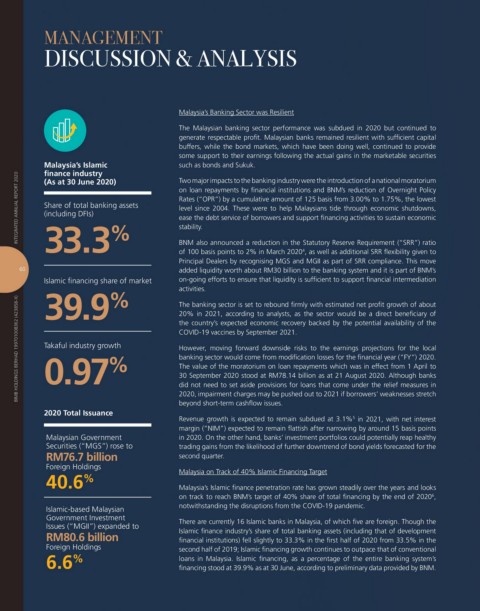
             40.6      %                       Malaysia’s Islamic finance penetration rate has grown steadily over the years and looks


                                               on track to reach BNM’s target of 40% share of total financing by the end of 2020 ,
                                                                                                                 6
             Islamic-based Malaysian           notwithstanding the disruptions from the COVID-19 pandemic.
             Government Investment
             Issues (“MGII”) expanded to       There are currently 16 Islamic banks in Malaysia, of which five are foreign. Though the
                                               Islamic finance industry’s share of total banking assets (including that of development
             RM80.6 billion                    financial institutions) fell slightly to 33.3% in the first half of 2020 from 33.5% in the
             Foreign Holdings                  second half of 2019; Islamic financing growth continues to outpace that of conventional
             6.6    %                          loans in Malaysia. Islamic financing, as a percentage of the entire banking system’s
                                               financing stood at 39.9% as at 30 June, according to preliminary data provided by BNM.

